Our products

Products

PULSE-WIDTH MODULATION POWER SUPPLY FOR SOLID-STATE RELAY CONTROL

cmi70

Downloads:

cmi70

• Direct control of synchronous solid-state relays using full-wave drive
• Switchable proportional setpoint input: 4–20 mA, 0–10 V, 0–20 V, potentiometer
• Application:
Control of heating resistors for:
– ovens, oil baths, industrial processes
– climate chambers,
– test benches…..


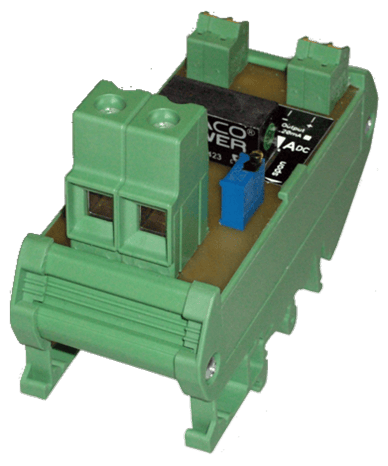
The CMi70 converter uses a standard analog signal (4–20 mA; 0–10 V; etc.) to generate a logic signal with a duty cycle ranging from 0 to 100% for controlling power units or solid-state relays
used in heating element control.

ANALOG-TO-PULSE-WAVEFORM CONVERTER FOR SOLID-STATE RELAY CONTROL

cmi30

Downloads:

cmi30

• Direct control of synchronous solid-state relays using full-wave drive (MLi, PWM)
– Fixed-rate mode
– Analog setpoint converter mode
• Switchable proportional setpoint
– Internal via potentiometer
– External (4–20 mA, 0–10 V, potentiometer)
• Application:
– Control of heating resistors for:
– furnaces, oil baths, industrial processes
– climatic chambers,
– test benches, etc.
• Voltage output or dry contact via solid-state relay: 0…10V
Analog-controlled (internal or external) power controller with variable duty cycle output
enabling control of a “zero-crossing” type solid-state relay for heating element regulation.

BATTERY CHARGER WITH ETHERNET CONNECTIVITY

Downloads:

chl70

For lithium, NiMH, or NiCd batteries

• Battery charger for automated test bench
Programmable charging current setpoint
Programmable compliance voltage
Battery voltage measurement
Charging current measurement
Continuous regulation of the setpoint current
Overvoltage and short-circuit protection circuit
Battery disconnect relay
Relay for switching the battery to an external circuit

• Ethernet Modbus TCP connection Embedded web server

• Internal communication bus Integrated into the DIN rail
Up to 15 chargers per bus

• Application:
Automated smart charger
The CHL70 is a battery charger that communicates via a TEH37 Ethernet head module,
allowing up to 15 chargers to be networked over a single Ethernet connection (Modbus-TCP protocol)
via the internal bus. This communication enables control of the charging current and duration,
as well as the battery voltage, making it an ideal tool for building automated charging stations.

BATTERY CHARGER WITH ETHERNET CONNECTIVITY

Downloads:

chl36

For lithium, NiMH, or NiCd batteries
TYPE: CHL36
• Battery charger for automated charging bench
Programmable charging current setting
Battery voltage measurement
Charging current measurement
Continuous regulation of set current
Overvoltage and short-circuit protection circuit
Battery disconnect relay
Relay for switching the battery to an external circuit

• Modbus TCP Ethernet connection
Embedded web server

• Internal communication bus
Mounted on a DIN rail
Up to 32 chargers per bus

• Application:
Automated smart charger
The CHL36 is a compact battery charger that communicates via an Ethernet head module
TEH36, enabling the networking of 32 chargers over a single Ethernet connection (Modbus-TCP protocol)
via the internal bus. This communication enables control of the charging current and duration,
as well as the battery voltage, making it an ideal tool for building automated charging stations.

GRAY CODE COMPARATOR FOR PARALLEL OUTPUT ENCODERS

Downloads:

ccn165

• 2 groups of 25 parallel digital inputs (4 to 25 bits in Gray code)

• 3 relay outputs + 1 watchdog output with programmable differential input thresholds

• Application: Synchronization control of two sensors


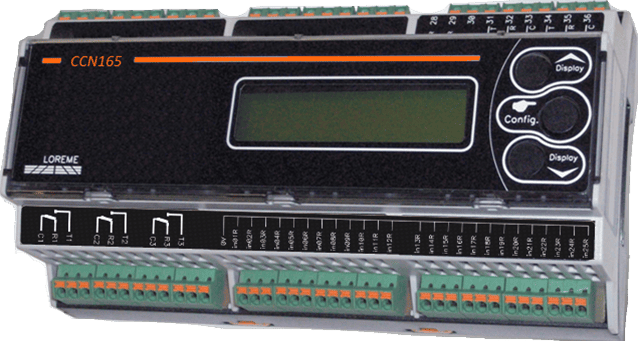
The CCN165 is a parallel digital comparator that enables simultaneous monitoring of two mechanical components. The relay outputs trigger a shutdown in the event of an excessive deviation or a failure in the operating
. The display allows for quick operational diagnostics and product configuration.
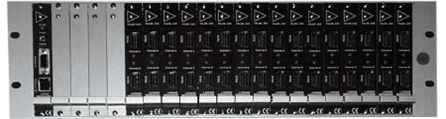
REMOTE I/O RACK WITH COMMUNICATION CAPABILITY

Downloads:

ccl20-cnl20-2

Modular data acquisition and control system:
Up to 32 analog inputs/outputs (programmable for temperature and process signals) Up to 256 digital inputs/outputs

Multi-protocol: Profibus, Modbus, Modbus TCP

Scalable: new protocols can be implemented simply by replacing the communication hub

General description:
A remote I/O rack communicating via an industrial protocol, this modular system consists of a communication hub
and, as needed, analog acquisition cards (programmable), digital input cards, analog output cards (programmable), or digital output cards. (16 slots are available)
* The 2-channel analog input cards (ref: CNL20-2/E) are configurable for mV, V, mA, thermocouple, or Pt100…
* The 2-channel analog output cards (ref: CNL20-2/S) are configurable for mA or V.
* The 16-channel digital input cards (ref: ELT 20-16) can be used as dry contact or polarized inputs from 5 to 50 Vdc.
* The 16-channel digital output cards (ref: SLT 20-16) offer 16 potential-free NO contacts (switching capacity 1A / 60Vac)
A universal version of the analog input/output cards is available (CNL20-2/ES), enabling operation in three different modes:
1) as a standard measurement converter without communication, 2) as a remote input, 3) as a remote output.
The communication hub is responsible for exchanging and buffering all input/output variables, thereby improving transfer speeds with external systems. This solution reduces the communication load on the control and monitoring stations (supervisors, PLCs, etc.), as the rack appears on the network as a single slave. The number of requests and the refresh time are therefore significantly reduced, thereby decreasing network congestion and the load on the PLC. The interchangeability of the communication hub allows for quick and easy migration of the rack to a new protocol.

4–20 mA ANALOG-TO-DIGITAL CONVERTER TO BCD – GRAY – BINARY

Downloads:

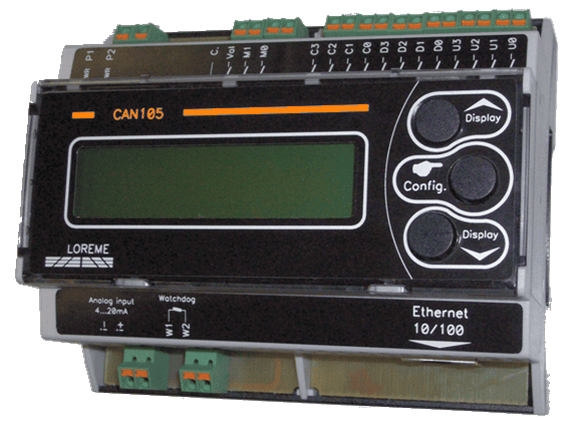
can105

• Analog Input
, 4–20 mA, 12-bit resolution

• Parallel digital outputs
, GRAY code, binary, or BCD
(14 bits + enable)

• Modbus TCP Ethernet Communication

The CAN105 is an analog-to-digital converter that converts an analog input signal (4–20 mA) into a binary, Gray, or parallel BCD (
) format; the display allows for quick diagnosis of proper operation (displaying the input current, the corresponding physical range, and the status of the outputs).

ALTERNATING VOLTAGE AND CURRENT CONDITIONER POWERED BY THE 4..20 MA LOOP

Downloads:

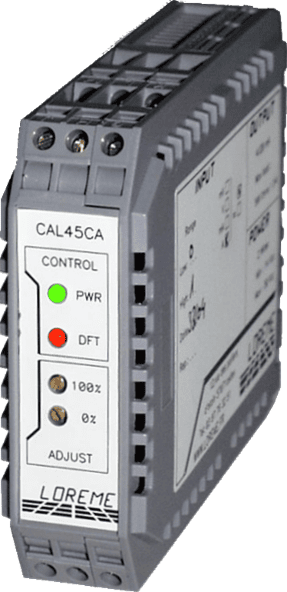
cal45ca

• Measurement of sinusoidal alternating signals (voltage or current)

• Direct input up to 250A and 1000V
• Galvanic isolation (up to 5000V)
• Accuracy: +/- 0.5%
• CAL45CA: measures 5A AC/DC; 500V AC/DC
• CAL45CAD: measures up to 50A AC; 1000Vac

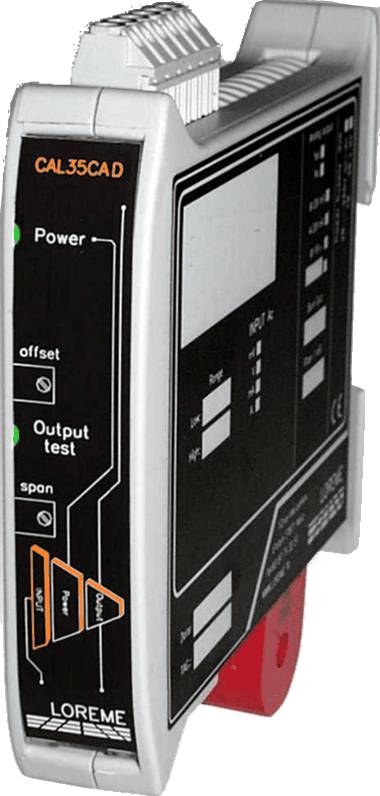
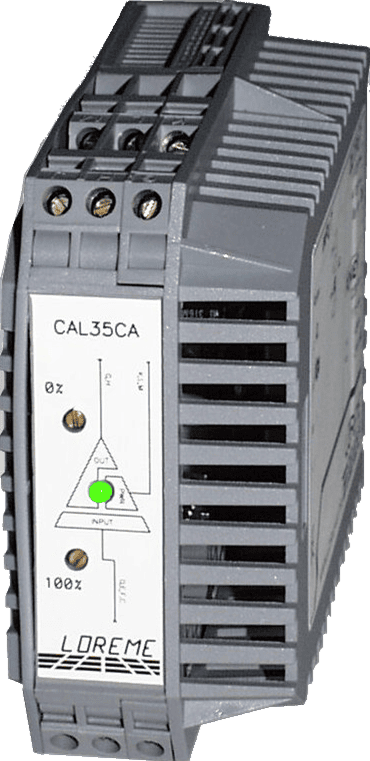
The CAL45CA family of measurement converters converts AC voltages or currents (
) into a 4–20 mA current proportional to the input value. The use of 2-wire technology (
, where the converter is powered by the 4–20 mA loop) simplifies wiring.

ISOLATED ANALOG TRANSMITTER POWERED BY THE 4..20MA LOOP

Downloads:

cal45

• CALP45: Pt100, Pt1000, Ptxxx input, 2- or 3-wire configuration
• CALT45: Thermocouple input
• CAL45: mV, V (dc), mA (dc), potentiometer input
• Isolation: input/output
• 2-wire technique powered by the 4-20mA loop

• LED for immediate monitoring of the loop and sensor
Green LED: 4–20 mA loop OK; Red LED: sensor fault

• SIL 2 and SIL 3 compliance in accordance with IEC 61508

The CAL45 series signal conditioners convert input signals from Pt100, thermocouples, mA, mV
, or potentiometers into a 4–20 mA current output using isolated 2-wire technology. Their use is recommended
to eliminate ground loops or to protect the data acquisition system.

ANALOG TRANSMITTER FOR PROBE HEAD MOUNTING

Downloads:

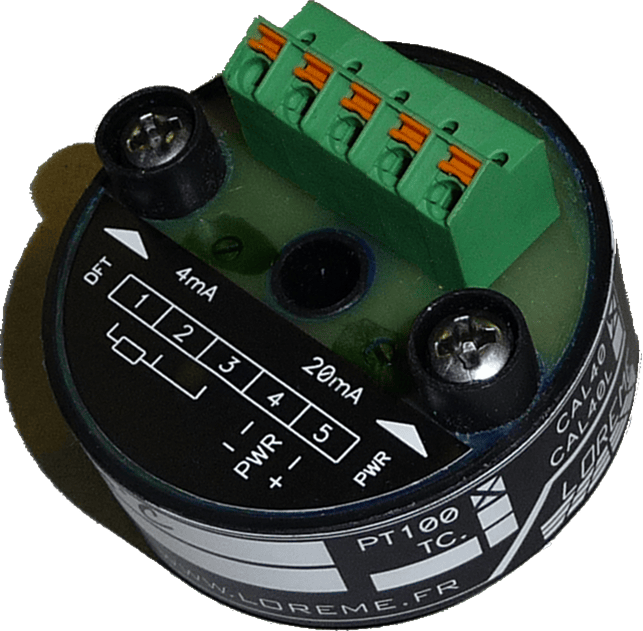
cal40

PT100, PT1000, or Potentiometer Input

• CALP40 Pt100–Pt1000 temperature transmitter
• CALpot40 Potentiometer input
• CALP40Si ATEX-certified intrinsically safe version
• Spring-loaded anti-vibration probe head mounting

• 2-wire technology powered by the 4–20 mA loop
• LEDs for immediate monitoring of the loop and sensor
Green LED: 4–20 mA loop OK
Red LED: sensor fault


• SIL2 and SIL3 compliance according to IEC 61508
The CAL40 measurement converter converts signals from temperature probes or position sensors (potentiometers) into a 4….20 mA 2-wire signal (powered by the measurement loop)
DESCRIPTION:
Input Temperature measurement:
– Pt100 or Pt1000 platinum resistance probes, 3-wire configuration
– Linearization and cable length compensation
– Customization of the measurement range at the end of manufacturing

Showing Slide 1 of 11