In the chemical, petrochemical, and pharmaceutical industries, electrical safety is a top priority. At the heart of this explosion protection is a component that is often overlooked but indispensable: the ATEX cable gland. Its primary role is to ensure the safe passage of cables through electrical enclosures while maintaining the seal and the integrity of the protection method.
However, when faced with Ex ia, Ex d, and Ex e markings, it’s easy to get confused. How do these different protection methods work, and how do you choose the right cable gland? This comprehensive guide explains it all.
1. The Ex d Cable Gland: Flameproof Protection
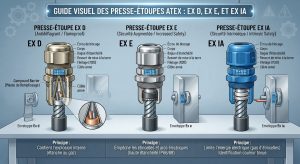
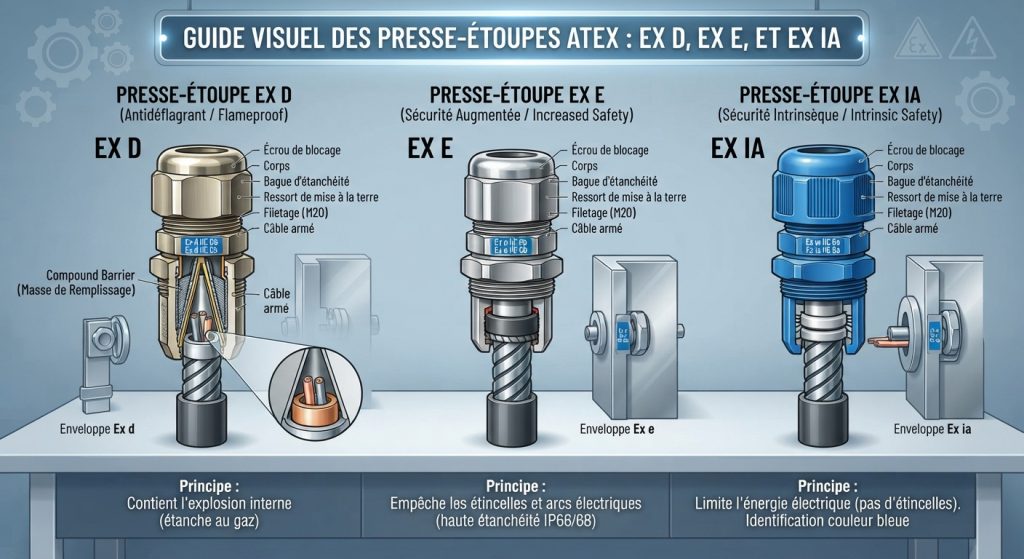
The Ex d protection type is based on the principle of containment. The enclosure is designed to withstand an internal explosion without allowing it to propagate into the surrounding atmosphere.
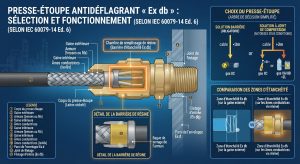
- The role of the Ex d cable gland: It must prevent flames and hot gases from traveling along the cable. To do this, it features a very robust seal or, in many cases, a filling compound (barrier compound). This resin completely surrounds the conductors to prevent any gas from passing through.
- Typical materials: Primarily metal (nickel-plated brass, stainless steel) to withstand mechanical stress.
- Ideal Application: Recommended for Zone 1 use in junction boxes for power equipment, motors, or floodlights.
2. The Ex e Cable Gland: Increased Safety
Unlike Ex d, the Ex e mode is designed to prevent the occurrence of any sparks, electric arcs, or hot spots inside the enclosure.
- The role of the Ex e cable gland: Since there is no internal explosion to contain, this cable gland is primarily used to ensure an excellent seal (IP66/IP68 rating) to prevent the ingress of moisture or conductive dust. It also provides a secure mechanical anchor for the cable to prevent it from being pulled out.
- Typical materials: Available in metal, but most commonly made of high-performance polyamide (plastic).
- Ideal Application: Perfect for junction boxes and terminal enclosures that do not generate sparks during normal operation.
3. The Ex ia Cable Gland: Intrinsic Safety
The Ex ia protection type limits the electrical and thermal energy entering the hazardous area. The currents and voltages there are so low that they cannot produce a spark capable of igniting the atmosphere.
- The Role of the Ex ia Cable Gland: Since the circuit itself cannot cause an explosion, the cable gland does not need to have flame-containment properties. It performs the same mechanical functions as an Ex e model (sealing and securing).
- Visual Distinction: To make it easy to identify intrinsically safe circuits, these cable glands (often made of plastic) have a blue collar or body.
- Ideal application: Used exclusively for instrumentation, temperature sensors, low-current valves, or data transmission.
Comparison Chart: Ex d vs. Ex e vs. Ex ia
| Feature | Ex d (Explosion-proof) | Ex e (Increased Safety) | Ex ia (Intrinsic Safety) |
|---|---|---|---|
| Philosophy | Contain the explosion inside | Prevents sparks from forming | Limits the available energy |
| Common Materials | Brass, stainless steel | Metal or Polyamide (black) | Polyamide (blue) |
| Distinctive Feature | Often with a filler mass | High mechanical strength & IP rating | Blue marking is required |
| ATEX Zones | Zones 1, 2, 21, 22 | Zones 1, 2, 21, 22 | Zones 0, 1, 2, 20, 21, 22 |
How to Choose the Right Cable Gland?
To confirm your final selection, you must meet these four essential criteria:
- Compatibility with the enclosure: An Ex e cable gland can generally be installed on an Ex e or Ex ia enclosure. However, an Ex d enclosure must use an Ex d-certified cable gland. Note that many industrial models are now dual-certified for Ex d and Ex e.
- Cable type: Determine whether your cable is armored (mechanically shielded) or non-armored. Models for armored cables include specific clamping rings for the armor.
- Cable diameter: The clamping range of the inner seal must match the cable’s outer diameter exactly to ensure IP sealing and Ex containment.
- Threads: Determine whether the thread is metric (e.g., M20, M25) or NPT (e.g., 1/2″, 3/4″).
Conclusion: The selection of an ATEX cable gland should never be taken lightly. An incorrect choice or improper installation (such as failing to apply resin to an Ex d cable gland where it is required) invalidates the certification of your entire electrical installation, creating a major industrial hazard.