Under the European Pressure Equipment Directive (PED 2014/68/EU), the regulatory status of a thermometric well (or casing) depends entirely on how it is marketed and how it is integrated into the system.
Here are the main rules governing the relationship between a thermometric well and the DESP:
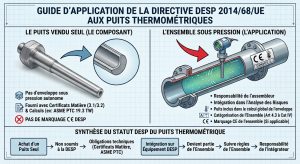
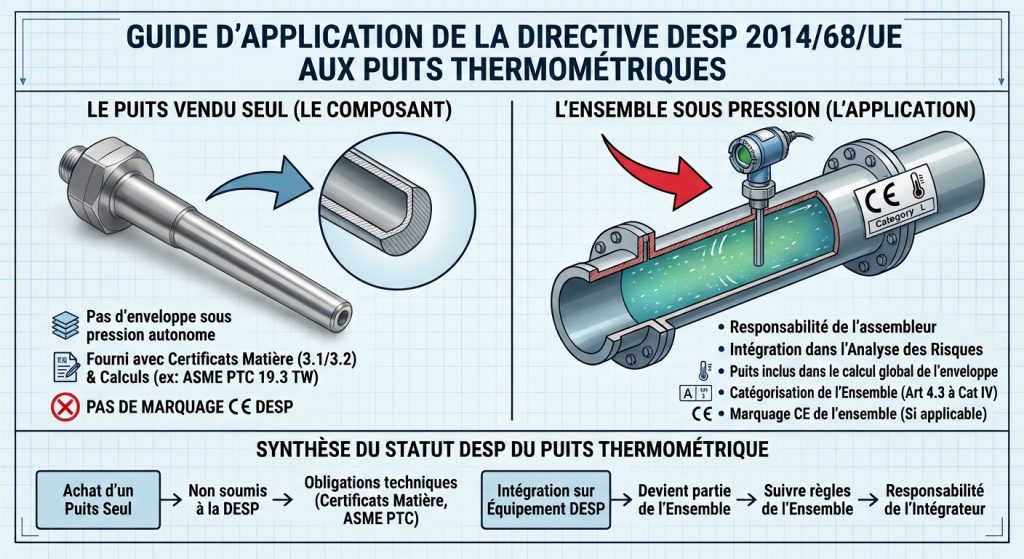
1. The well sold separately: A “component” (No CE marking)
When a temperature well is purchased separately from an instrumentation manufacturer, it is generally considered a component of pressure equipment rather than a stand-alone piece of pressure equipment within the meaning of the directive.
- No CE Marking Under the DESP: The temperature well alone does not receive CE marking under the DESP.
- Manufacturer's obligation: The manufacturer must provide complete technical documentation that enables the integrator to verify compliance (Type 3.1 material certificates, test reports, dimensions).
2. The Integrated Well: Overall Responsibility
As soon as the temperature well is welded or screwed onto a pipe or tank subject to the DESP, it becomes an integral part of that pressurized enclosure.
- Overall Assessment: It is the manufacturer or assembler of the final system (the assembly) who must incorporate the well into its risk analysis and strength calculation.
- The system category: The nature of the fluid (gas/liquid, hazardous or non-hazardous), the maximum allowable pressure (PS), and the volume (V) or nominal diameter (DN) of the main pipeline determine the DESP risk category (from Article 4.3 to Category IV).
3. Essential Technical Requirements
Even though the thermometric well is not individually CE-certified, its operating conditions (high pressures, high flow rates, induced vibrations) require strict compliance with best practices.
- Material traceability: Nearly universal use of stainless steel or specific alloys, accompanied by a material certificate (EN 10204 3.1) to verify mechanical strength.
- Mechanical Strength Calculation: Verification of the casing’s resistance to wake forces and fluid pressure (generally in accordance with ASME PTC 19.3 TW).
- Weld Inspection: If the well is of a mechanically welded design, welder qualifications (QS) and welding procedures (QMOS) must meet the requirements of the DESP if the final equipment so requires.
The ASME PTC 19.3 TW (Thermowells) standard is the international benchmark for calculating the mechanical strength of solid-machined thermowells.
As part of regulatory filing DESP 2014/68/EU, this calculation note is essential. It demonstrates that the thermometric well will withstand the mechanical stresses of the pressurized fluid.
Here are the four main acceptance criteria validated by the calculation:
1. The Frequency Ratio (The Major Risk)
When a fluid flows around a well, it creates vortices behind it (the Von Kármán wake phenomenon). These vortices generate vibrations.
- The rule: The frequency of these vortices must not resonate with the natural frequency of the thermometric well.
- The criterion: The ratio of the fluid's excitation frequency to the well's natural frequency must generally be less than 0.8.
2. Static Stress (Pressure)
The fluid exerts an external hydrostatic pressure on the thermowell casing.
- The criterion: The stress experienced by the material must not exceed the maximum allowable stress for the metal at the maximum operating temperature.
3. Dynamic Stress (Bending)
The impact force of the fluid (dynamic drag) causes the well to bend slightly.
- The criterion: The combination of dynamic bending stress and static pressure at the base of the well must remain below the fatigue limit of the selected material.
4. Peak hydrostatic pressure
- The criterion: The wall thickness at the tip (the end of the well) must be sufficient to withstand the tip pressure exerted from the front by the moving fluid.
Why does the DESP require this calculation?
Even if the well is simply a “component” (without its own CE marking), the purchaser or engineering firm that integrates it into a DESP piping system must perform a Risk Analysis. The ASME PTC 19.3 TW calculation serves as technical justification for the design when submitted to a Notified Body (such as Bureau Veritas, Apave, TÜV, etc.) to ensure the safety of the pressurized assembly.