Glassmaking is one of the most fascinating industrial processes in the world, but also one of the most demanding. To transform sand, sodium carbonate, and limestone into a transparent, pure material, glassworks must withstand extreme temperatures that often exceed 1,500 °C.
In this blazing-hot environment, the difference between a perfect piece of glass and a defective batch comes down to a matter of a few degrees. This is where industrial temperature sensors come into play—true guardians of quality and energy efficiency.
Discover how these cutting-edge technologies measure the invisible to shape our daily lives.
Why is temperature control essential in a glassworks?
Glass does not tolerate improvisation. Even the slightest temperature fluctuation can ruin the entire production line. Rigorous monitoring using temperature control solutions addresses four key requirements:
- Uniform Melting: Ensure that all raw materials melt evenly.
- Defect Detection: Preventing the formation of air bubbles, streaks, or structural irregularities that weaken the product.
- Energy Efficiency: Heating industrial furnaces requires an astronomical amount of energy. Precise control allows for optimal heating adjustments, thereby reducing costs and the carbon footprint.
- Heat treatment (annealing): Cooling the glass too quickly creates critical internal stresses. The temperature must be lowered according to a highly controlled curve to ensure the strength of the final product.
The Two Leading Technologies: Contact vs. Contactless
Given such extreme conditions, two main types of sensors are used in glassworks to monitor the processes.
| Technology | Application Type | Benefits | Limitations |
|---|---|---|---|
| Thermocouples (With Contact) | Immersion in the molten glass bath, furnace vaults. | Extremely high resistance (up to 1,800 °C), durable, and cost-effective. | Chemical wear caused by molten glass requires protective linings made of precious metals (platinum). |
| Optical Pyrometers (Noncontact) | Measurement of the glass surface, forming and laminating areas. | Instantaneous remote measurement; no mechanical wear; does not damage the material. | Sensitive to dust, factory fumes, and reflections from the surroundings. |
1. Thermocouples: The Warriors of Fire
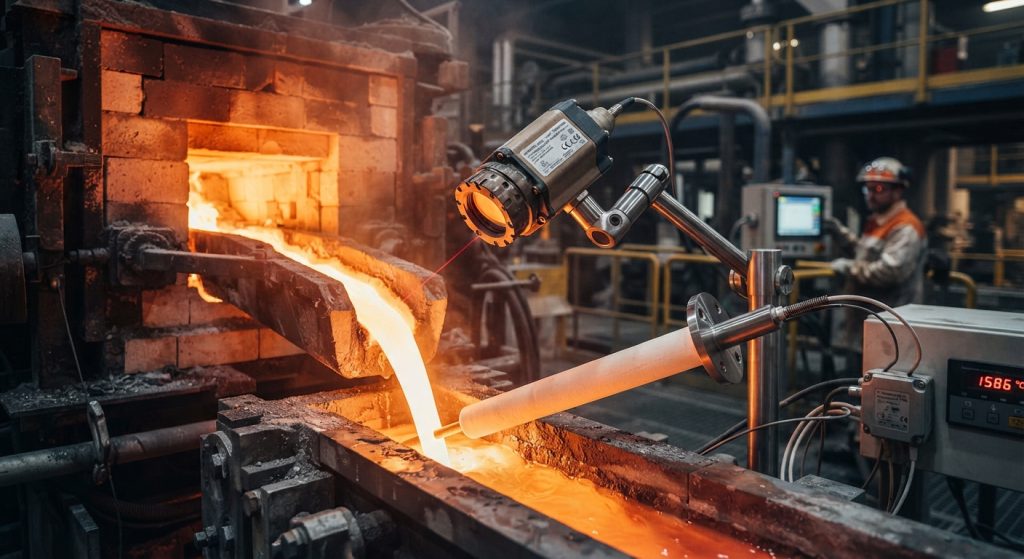
To measure the temperature directly at the core of the molten glass, engineers rely on high-temperature thermocouples. By harnessing the Seebeck effect (an electrical voltage generated by the temperature difference between two distinct metals), they have established themselves as the most durable solution. In glass, type R, S, or B thermocouples are primarily used; these are made of platinum and rhodium so they do not melt instantly.
2. Pyrometers: Accuracy from a Distance
Glass has a complex optical property: its emissivity varies depending on its composition and thickness. Optical pyrometers calculate temperature by analyzing the infrared radiation emitted by the glass. They are essential during the forming stages (bottles, flat glass) where no physical sensor can come into contact with the material, as this would mark or deform it.
The Extreme Challenges of the Glass Industry
Choosing the right sensor isn't enough; it has to survive. Sensor manufacturers face grueling conditions:
- Chemical corrosion: Molten glass is an extremely aggressive solvent that corrodes most metals. The sensors must be protected by industrial probes with sealed ceramic sheaths.
- Thermal shocks: Going from room temperature to over 1,000 °C during installation can instantly break the protective covers.
- Electromagnetic interference: The high currents used to heat furnaces with electrodes can distort the electrical signals from measuring instruments.