In industrial temperature measurement, the choice of temperature sensor (PT100, thermocouple, etc.) is crucial, but the choice of extension or compensation cable is just as important. The cable’s insulation determines the sensor’s resistance to extreme temperatures, humidity, chemicals, and mechanical stress.
Here is a detailed comparison of the main insulation materials (PVC, PFA, PTFE, silicone, and glass fiber) to help you make the right choice.
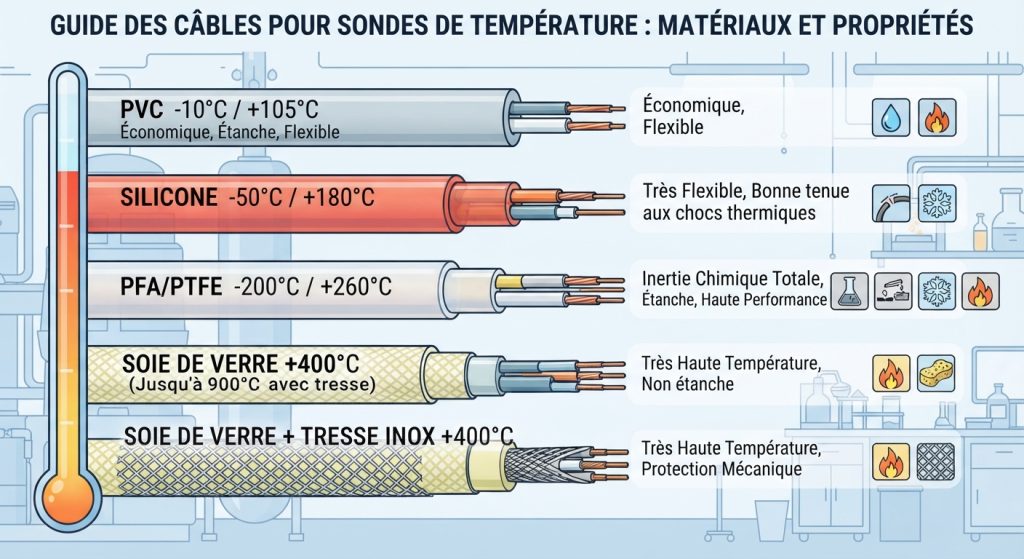
Comparison Chart of Cable Insulation Materials
| Material | Ideal temperature range | Chemical Resistance | Moisture Resistance | Flexibility | Typical Applications |
|---|---|---|---|---|---|
| PVC | -20°C to +105°C | Average | Excellent | Good | Food and Beverage, HVAC, Economic Applications |
| Silicone | -50°C to +180°C (peak at 200°C) | Good | Excellent | Very high | Light industrial ovens, refrigeration, HVAC engineering |
| PFA / PTFE | -200°C to +260°C | Exceptional (total) | Excellent (waterproof) | Average | Chemistry, pharmaceuticals, cryogenics, laboratories |
| Glass fiber | 0°C to +400°C (up to 900°C with stainless steel braiding) | Low | Poor (porous) | Low | High-temperature furnaces, metallurgy, plastics processing |
A Closer Look at Each Material
1. PVC (Polyvinyl Chloride): The Economical Option
PVC is the most commonly used standard material for low-temperature applications.
- Advantages: Very economical, excellent water resistance, good flexibility.
- Disadvantages: Its maximum temperature is limited (usually 105°C). It emits toxic fumes in the event of a fire.
- Ideal for: Heating, ventilation, and air conditioning (HVAC) and the food processing industry (excluding cooking processes).
2. Silicone: Ultimate Flexibility
Silicone rubber offers an excellent balance for moderate temperatures.
- Advantages: Extremely flexible (ideal if the cable needs to move frequently), good resistance to thermal shock.
- Disadvantages: Less resistant to cuts and mechanical damage (tearing) than fluoropolymers.
- Ideal for: Ovens, refrigeration systems, and environments requiring frequent handling.
3. PFA and PTFE (Fluoropolymers): Extreme Durability
Note: The term “PFE” is sometimes used incorrectly, but the true industry standards are PTFE (Teflon) and PFA (which offers better gas tightness and a better surface finish).
- Advantages: Virtually complete chemical inertness (reacts with almost no acids or solvents) and an impressive temperature range (from cryogenic temperatures to +260°C). They are completely impermeable.
- Disadvantages: Stiffer cables and higher cost.
- Ideal for: The chemical and pharmaceutical industries, laboratories, and highly corrosive environments.
4. Glass Silk: Extremely High Temperatures
Glass fiber (often reinforced with an outer stainless steel braid) is essential whenever temperatures exceed 300°C.
- Advantages: Withstands very high temperatures (up to 400°C continuously, and some variants containing ceramic fiber exceed 900°C).
- Disadvantages: Not waterproof. Glass fiber absorbs moisture and liquids, which can cause electrical insulation failures (short circuits or measurement errors).
- Ideal for: Foundries, industrial furnaces, plastic injection molding, and heat treatment.
3 Golden Rules for Choosing Your Cable
- Check the thermal environment: Don't just look at the process temperature; also consider the ambient temperature where the cable will run.
- Be careful with moisture: If your environment is humid or frequently washed with water, avoid glass fiber and opt for PFA or silicone instead.
- Consider friction: If the cable is subject to mechanical friction, add a stainless steel shielding braid over the insulation (optional for PVC, PTFE, or glass fiber) to protect it from being cut.