In a cement plant, accurate temperature measurement is crucial for ensuring clinker quality and optimizing energy consumption. However, temperature sensors are subjected to extreme conditions: intense abrasion, thermal shock, chemical corrosion, and temperatures approaching 1,200°C.
To protect these sensors, protective sleeves (made of metal or ceramic) are used. But when faced with the force of material flows, standard stainless steel is no longer sufficient. This is where the Stellite® coating comes in .
What is Stellite, and why use it?
Stellite is a family of non-ferrous alloys based on cobalt and enriched with chromium, tungsten, and carbon.
This unique composition gives it exceptional properties that are essential in the cement industry:
- Exceptional high-temperature hardness: Unlike conventional steels, which soften as the temperature rises, Stellite retains its mechanical hardness even at very high temperatures (up to 700°C–800°C, depending on the grade).
- Extreme resistance to abrasion and erosion: The chromium and tungsten carbides present in the cobalt matrix act as an ultra-hard shield against the constant barrage of clinker or raw material particles.
- Excellent resistance to corrosion and oxidation: Chromium forms a protective passive layer that resists aggressive combustion gases (sulfur, chlorine).
Critical Areas in a Cement Plant
In a cement plant, not all measurement points require Stellite. The focus is primarily on areas where high-temperature, abrasive materials pass through:
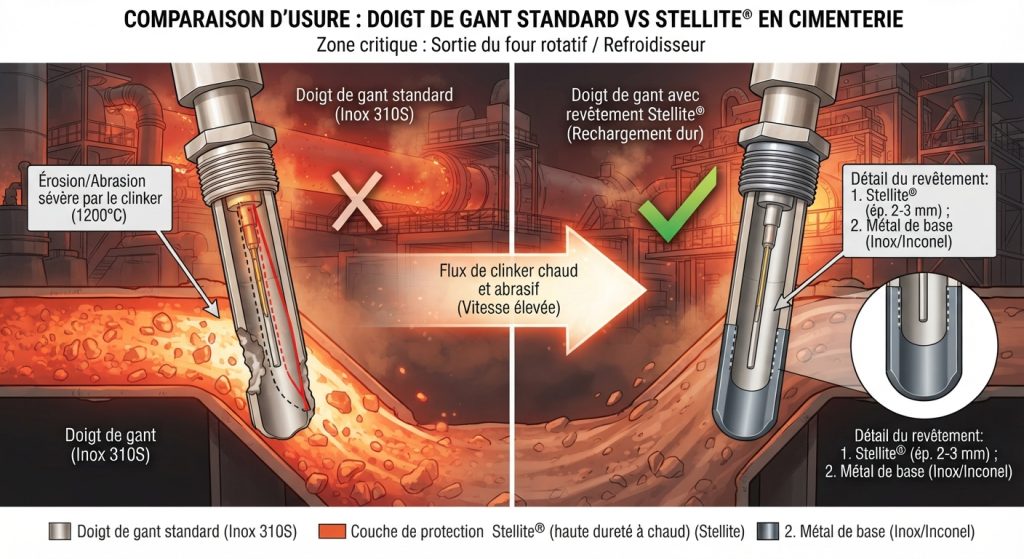
- The rotary kiln outlet (clinker discharge zone): This is the most critical area. The clinker exits at approximately 1,300°C–1,400°C in the form of ultra-abrasive granules. The liner tubes are subjected to maximum mechanical erosion in this area.
- The clinker cooler (grid cooler): The forced-air system used to cool the clinker creates a cyclonic flow of hard dust that literally wears down the measuring instruments.
- The Preheating Tower (Cyclones): Hot gases carry the raw ore (limestone, clay) at high speed, causing impact erosion on the liners suspended in the flow.
Application Techniques: How Do You Put on a Finger Sleeve?
Stellite is not used to manufacture the entire liner (which would be extremely costly and difficult to machine). Instead, it is applied as a surface layer ( hardfacing) onto a base of heat-resistant steel (such as Inconel 600 or 310 steel).
The most common techniques are:
- PTA (Plasma Transferred Arc) cladding: Provides excellent metallurgical bonding with very little dilution of the Stellite into the base steel, ensuring maximum hardness starting with the first layer.
- Thermal spraying (HVOF or plasma spraying): Ideal for applying thin, high-density coatings to complex geometries.
- Laser Cladding: A modern technique that allows for ultra-precise thickness control, minimizing thermal deformation of the sleeve.
📈 Economic and Operational Benefits
Investing in Stellite-coated sleeve liners involves a higher initial cost, but the return on investment (ROI) is quick:
| Feature | Standard sleeve (Stainless Steel / Bare Refractory) | Sleeve with Stellite® coating |
| Average lifespan | A few weeks to 3 months | 12 to 24 months (depending on the region) |
| Risk of measurement drift | High (thickness wear distorts thermal conductivity) | Very low (geometry remains stable over time) |
| Maintenance | Frequent stops for replacement | Planning only during annual maintenance shutdowns |
| Process Safety | Risk of breakage and foreign material entering the sensor | Maximum thermocouple protection |
In conclusion
The Stellite coating on thermowells is a proven solution for ensuring reliable temperature measurements in cement plants. By dramatically extending the service life of measurement equipment, it prevents unplanned production shutdowns, enhances plant safety, and enables optimal control of the kiln process.