While the choice of sensor (thermocouple or PT100 probe) is crucial, another factor plays an equally vital—yet often underestimated—role: the protective sheath.
When conditions become extreme, standard metal conduits quickly reach their limits. That's where ceramic conduits come in.
What is a ceramic protective sleeve?
A ceramic sheath is a tube closed at one end, designed to encase the temperature sensor. Its primary function is to protect the internal wires from external hazards (high temperatures, thermal shocks, corrosive environments) while allowing for optimal heat transfer to ensure accurate measurements.
The 3 Major Advantages of Ceramics
1. Unmatched resistance to extreme temperatures
Where most metals begin to melt or deform, ceramics remain unyielding. Depending on the material chosen, a ceramic sleeve can withstand temperatures ranging from 1,200 °C to over 1,800 °C. It is the ideal choice for high-temperature vitrification processes, metallurgy, and aerospace research.
2. Resistance to corrosion and chemical attack
In industrial environments, sensors are often exposed to corrosive gases, acids, or molten metals. Ceramic sheaths offer excellent chemical inertness. They do not oxidize and do not react with the surrounding elements, which prevents premature degradation of the sensor.
3. Perfect electrical insulation
At very high temperatures, ceramic is an exceptional natural electrical insulator. It ensures that the signal measured by your probe will not be interfered with.
Alumina (C799) vs. Sillimanite (C610): Which Material Should You Choose?
Not all ceramics are created equal. The two types most commonly used for protective sleeves are:
- Pure alumina (often classified as C799):
- Maximum temperature: Approximately 1,700 °C to 1,800 °C.
- Advantages: Perfect gas tightness and maximum temperature resistance.
- Weakness: Sensitive to thermal shock (sudden temperature changes).
- Sillimanite / Mullite (often classified as C610):
- Maximum temperature: Approximately 1,400 °C to 1,500 °C.
- Advantages: Excellent resistance to thermal shock and improved mechanical strength.
- Weakness: Slightly more permeable to certain gases than pure alumina.
Industries that can no longer do without it
Ceramic liners are used wherever operating conditions are considered “severe”:
- Glass and Ceramics: For monitoring firing and melting furnaces.
- Steelmaking and Foundry Operations: For measuring the temperature of molten metals.
- Incineration and Chemistry: Where combustion gases would destroy any metal in a matter of days.
It is true that ceramic liners are more susceptible to mechanical damage (impacts, drops) than metal. However, when installed correctly, their durability and reliability at high temperatures drastically reduce maintenance costs and production downtime.
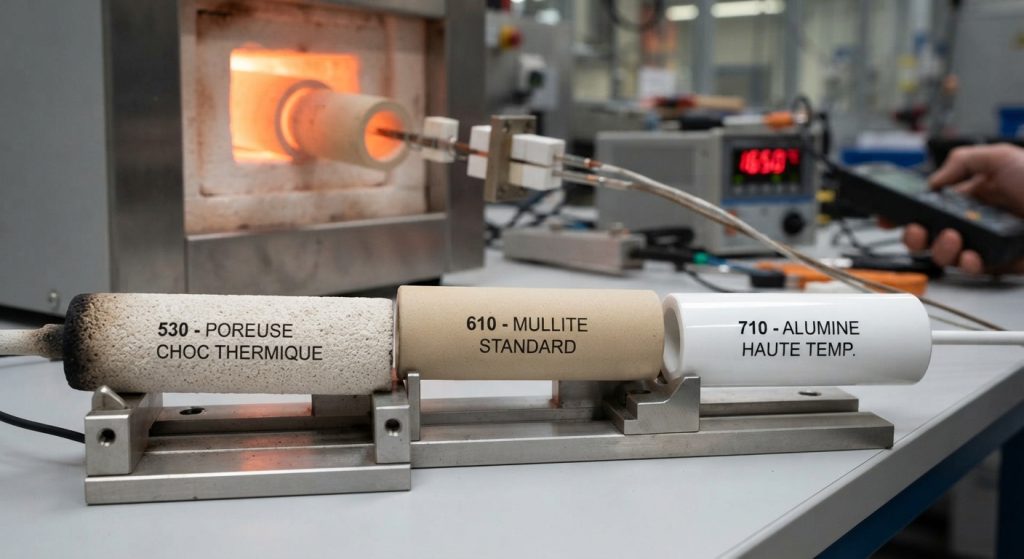
How do you choose the right ceramic sheath (530, 610, 710) for temperature sensors?
Accurately measuring temperatures exceeding 1,000 °C is a challenge. While the choice of thermocouple (Type K, S, R, or B) is essential, its durability depends entirely on its protection. When exposed to corrosive atmospheres and extreme heat, metal sheaths fail. This is where technical ceramics come into play.
What are the main differences between 530, 610, and 710 conduits, and how do you make the right choice?
Material Specifications: 530 vs. 610 vs. 710
The choice of a sheath depends on three key factors: maximum temperature,gas tightness, and thermal shock resistance.
1. Ceramic 530 Lining (Pormulit / Porous Silicates)
The C530 tube is a porous ceramic composed primarily of alumina and silica.
- Maximum temperature: Approximately 1,350 °C.
- Its key strength: Exceptional resistance to thermal shock. Thanks to its porous structure, it can withstand sudden, extreme temperature fluctuations without cracking.
- Its weakness: Its porosity makes it permeable to gases. It cannot effectively protect the internal wires of a thermocouple from external chemical contamination.
- Ideal application: Used as an outer protective sheath (primary mechanical shielding) or in processes involving rapid thermal cycling.
2. The Ceramic 610 Liner (Pythagoras / Mullite)
The C610 sleeve is the industry's versatile standard, made from aluminum silicate (mullite).
- Maximum temperature: Approximately 1,400 °C to 1,500 °C.
- Its key strength: An excellent balance. It provides good gas tightness while maintaining respectable resistance to temperature fluctuations.
- Its weakness: It is less waterproof and less heat-resistant than the 700 series.
- Ideal Use: Perfect for standard Type K thermocouples in conventional industrial furnaces or for heat treatment of metals.
3. The 710/799 Ceramic Liner (Alsint / Pure Alumina)
The C710 lining (often considered equivalent to Alsint or Class C799) represents the very top of the line, consisting of more than 99% pure alumina.
- Maximum temperature: Up to 1,700 °C or even 1,800 °C.
- Its key advantage: Absolute gas tightness and perfect chemical inertness. It prevents any contamination of the precious metals that make up the sensor.
- Its weakness: It is very sensitive to thermal shock. Its temperature must be raised or lowered very gradually, or it may break.
- Ideal use: Essential for protecting valuable thermocouples (S, R, B) in the glass industry, the metallurgical industry (molten metals), and state-of-the-art laboratories.
Comparative Overview to Help You Make Your Choice
| Ownership | Ceramic 530 (Porous) | Ceramic 610 (Mullite) | Ceramic 710 / 799 (Alumina) |
| Max Temperature | ~ 1,350 °C | ~ 1,450 °C | ~ 1,750 °C |
| Gas Tightness | Poor (Porous) | Good (Waterproof) | Excellent (Airtight) |
| Thermal Shock Resistance | Excellent | Moderate | Low (Fragile) |
| Associated sensor type | External shielding | Standard thermocouple (K, J) | Precious Metals (S, R, B) |
Why are "double sheaths" sometimes used?
In the most demanding applications (such as an incinerator or a foundry), engineers often combine these materials.
For example, an inner C710 sheath is used to hermetically seal the thermocouple from the gases; this sheath is inserted inside an outer C530 (or silicon carbide) sheath, which absorbs the thermal and mechanical shocks of the production flow.
In conclusion
- Choose the 530 if your top priority is withstanding sudden temperature changes without the risk of direct mechanical impact.
- Choose the 610 for your general industrial applications at temperatures below 1,400°C.
- Choose the 710 whenever you're working with noble-metal thermocouples or in a highly corrosive gas environment.