The dielectric strength of temperature sensors is a crucial factor for safety and accuracy in industrial environments. Although sensors (such as Pt100 probes or thermocouples) are often evaluated based on their measurement range, their ability to insulate electrical circuits from the outer metal sheath is vital
In the world of industrial instrumentation, the choice of a temperature sensor is often based on obvious criteria: accuracy, response time, and mechanical strength. However, there is one invisible yet essential parameter for ensuring the safety of installations and the reliability of measurements: dielectric strength.
What is dielectric strength? Why is it affected by temperature, and how can you ensure that your probes don’t cause short circuits? We’ll explain everything.
What is the dielectric strength of a sensor?
Dielectric strength, which is closely related to dielectric rigidity, refers to the maximum electrical voltage that an insulator can withstand before an electric arc forms.
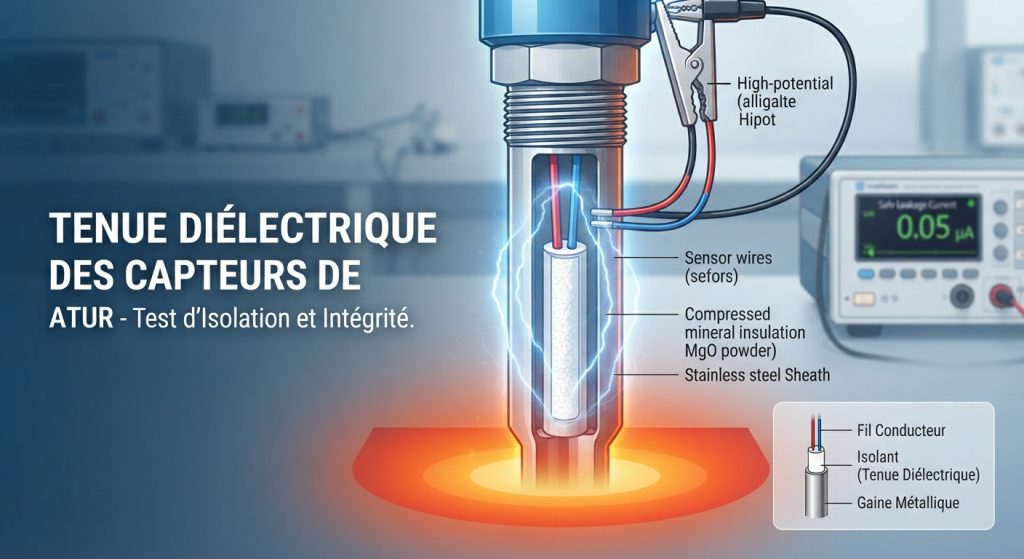
In a temperature sensor (such as a mineral-insulated Pt100 probe or a thermocouple), the conductive wires that carry the electrical signal are separated from the outer protective metal sheath by an insulating material (usually compacted magnesia, alumina, or polymers).
- The objective: To prevent the measured signal from “leaking” into the system or from parasitic voltages in the plant from distorting the temperature measurement.
The Arch-Enemy: Insulation Deterioration Due to Temperature Changes
One of the biggest pitfalls in materials physics is that electrical insulation decreases as the temperature rises.
When your sensor is pushed to its thermal limits, the internal structure of the insulating material (for example, ceramic) is subjected to stress:
- Thermal motion: It releases electrical charges within the insulating material, making it naturally more conductive.
- Moisture penetration: If the sensor’s waterproofing is compromised by repeated thermal cycles, moisture seeps in. Water has a high dielectric constant, which causes the insulation resistance to drop dramatically.
If the dielectric strength fails, a leakage current occurs. For the user, this results in a persistent drift in the measurement or a complete failure of the data acquisition system.
Stress Testing: Dielectric Withstand Test (Hipot Test)
To verify that a sensor is completely safe before it is put into service, manufacturers conduct standardized tests using high-voltage test systems.
The protocol involves applying a high voltage (for example, 500 V DC or higher) between the sensor’s measurement leads and its outer sheath. If the insulation holds up without allowing any current to pass through (or only a negligible amount, expressed in microamperes), the sensor is approved for industrial use.
How can we ensure good dielectric strength in the field?
To avoid unpleasant surprises in your production processes, here are some best practices to follow:
- Choose mineral insulation: For high temperatures, opt for mineral-insulated cables (stainless steel or Inconel sheath filled with magnesium oxide). They offer excellent thermal and dielectric performance over time.
- Protect against moisture: Make sure the sensor’s connection head has an appropriate protection rating (IP65/IP67) to prevent condensation from seeping into the insulation.
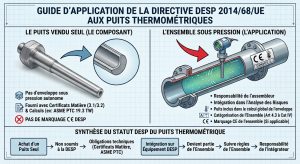
- Use a protective sleeve: A protective sleeve mechanically isolates the sensor from corrosive or high-pressure fluids, thereby indirectly protecting its electrical insulation.
In conclusion
Neglecting the dielectric strength of a temperature sensor can lead to phantom measurement errors and unexplained production stoppages. When drafting your next instrumentation specifications, be sure to verify the breakdown voltage and insulation resistance of your probes, especially if they are intended for use in harsh environments.