In the industrial world, temperature is one of the most frequently measured and critical physical variables. Whether it is to ensure the safety of a chemical reaction, validate pasteurization in the food industry, or optimize the casting of molten metals, the choice of an appropriate temperature sensor directly determines the quality and safety of the process.
However, given the wide variety of technologies available (RTDs, thermocouples, thermistors, infrared), finding the ideal sensor can quickly become a challenge. This comprehensive guide reviews the different types of industrial temperature probes to help you make the best decision.
Comparative Overview of Measurement Technologies
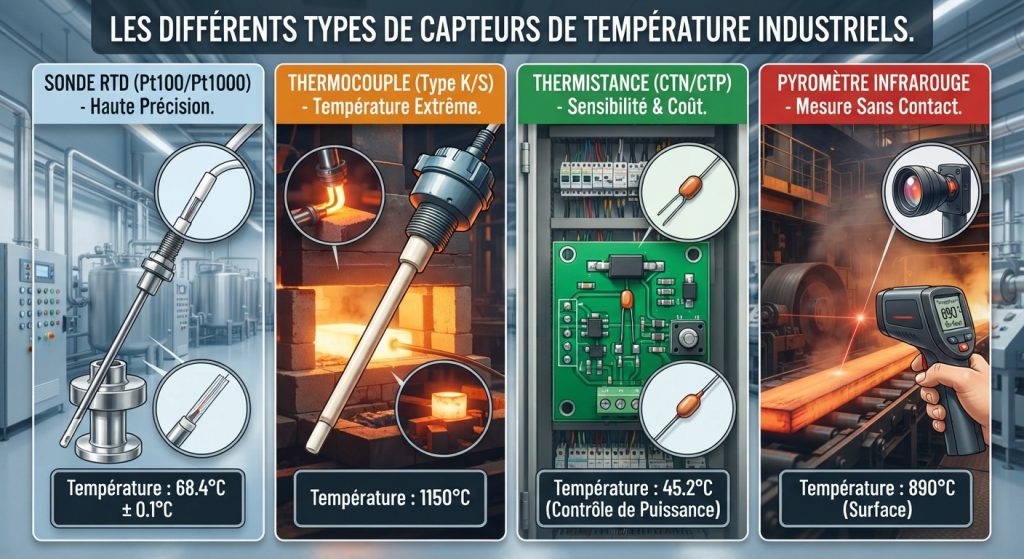
To give you an immediate overview, here is a direct comparison of the four major sensor families:
| Technology | Typical temperature range | Clarification | Reliability / Strengths | Ideal Applications |
| RTD Probes (Pt100 / Pt1000) | -200°C to +600°C | Excellent (~0.1°C) | Highly stable over the long term, linear measurement | Pharmaceuticals, Food and Beverage, Laboratories |
| Thermocouples (K, J, T, S, etc.) | -250°C to +1200°C+ | Average (+/- 1°C to 3°C) | Extremely durable, fast response time | Industrial Furnaces, Metallurgy, Glass Manufacturing |
| Thermistors (CTN / CTP) | -50°C to +300°C | Good (on a limited scale) | Cost-effective, very high sensitivity | Battery Monitoring, Air Conditioning, Motors, Transformers |
| Infrared (Non-contact) | -50°C to +3,000°C | Variable | Ideal for moving or inaccessible targets | Conveyors, Moving Parts, Maintenance |
1. Resistance Temperature Detectors (RTDs): Unmatched Accuracy
Resistance temperature detectors (RTDs), such as Pt100 or Pt1000 probes, take advantage of the physical property of a metal (usually platinum) whose electrical resistance increases almost linearly as the temperature rises.
- Their strengths: Unmatched long-term stability and optimal accuracy (often better than 0.1°C).
- Their limitations: Higher cost, a slightly slower response time than a thermocouple, and susceptibility to strong vibrations.
- What are they used for? Choose RTDs for critical processes where even a tenth of a degree matters, such as in the pharmaceutical or food processing industries.
2. Thermocouples: Durability for Extreme Conditions
A thermocouple consists of two metal wires of different types that are welded together at one end. When there is a temperature difference between this junction (hot junction) and the other end (cold junction), an electric voltage (Seebeck effect) is generated.
There are different types of thermocouples suited to each environment:
- Type K (Chromel/Alumel): The most versatile and economical, with a temperature range up to 1200°C.
- Types R, S, and B: Made of noble metals (platinum/rhodium) to withstand the extreme temperatures found in the steel industry (up to 1,600°C).
- Their strengths: Exceptional durability, a compact size that enables instant response times, and very affordable prices.
- Their limitations: Less accurate than a Pt100 and prone to drift over time.
- What are the applications? Industrial furnaces, foundries, glass manufacturing, and the petrochemical industry.
3. Thermistors (CTN and CTP): Cost-effective and sensitive
Thermistors are semiconductor components (metal oxides) whose resistance varies nonlinearly with temperature. There are two types: NTCs (Negative Temperature Coefficient: resistance decreases as temperature rises) and PTCs (Positive Temperature Coefficient).
- Their strengths: Extreme sensitivity to small temperature variations and very low cost.
- Their limitations: A narrow measurement range (generally limited to 300°C) and significant nonlinearity, which requires software processing of the data.
- What are the applications? Monitoring communication equipment, air conditioning systems, or thermal protection for engines.
4. Infrared Sensors: Noncontact Measurement
Unlike the three previous technologies, which require physical contact with the environment (invasive sensors), infrared sensors calculate temperature from a distance by measuring the radiant energy emitted by an object’s surface.
- Their advantages: No risk of contamination; ideal for measuring fast-moving, high-voltage, or extremely hot objects.
- Their limitations: The measurement depends heavily on the emissivity of the target surface (for example, shiny, reflective metals are difficult to measure without preprocessing).
- What are the applications? Quality control on automated production lines, conveyor belt monitoring, and predictive electrical maintenance.
The 4 Key Criteria to Consider When Making Your Choice
To select the perfect sensor for your next project, methodically analyze your needs using these criteria developed by instrumentation experts
- Temperature range: There’s no point in choosing a noble-metal thermocouple if your process operates at a constant 80°C. Look for a technology where your nominal temperature falls in the middle of the sensor’s operating range.
- Mechanical and Chemical Environment: Will the sensor be exposed to acids? To strong vibrations? To high pressure? The choice of protective housing (stainless steel, ceramic) is just as important as the sensing element itself.
- Process Dynamics (Response Time): If your process is subject to extremely rapid temperature fluctuations, opt for a thermocouple with low thermal mass or an infrared measurement system.
- The Required Accuracy: Could a 2°C deviation jeopardize your production? If so, an RTD (Pt100) sensor is required. If not, opt for the cost-effective durability of a thermocouple.