In the field of industrial temperature measurement, the thermocouple is an indispensable sensor. Rugged, cost-effective, and capable of measuring extreme temperatures, it is used in everything from industrial furnaces to chemical reactors. Yet this instrument faces a paradox: it cannot measure absolute temperature on its own.
To obtain an accurate reading, it relies entirely on an electronic process called cold-junction compensation (CJC). Without it, your temperature readings would be skewed by simple fluctuations in the ambient temperature of your room.
Learn how this essential mechanism works and why it ensures the accuracy of your measurements.
The problem: the Seebeck effect and the temperature difference
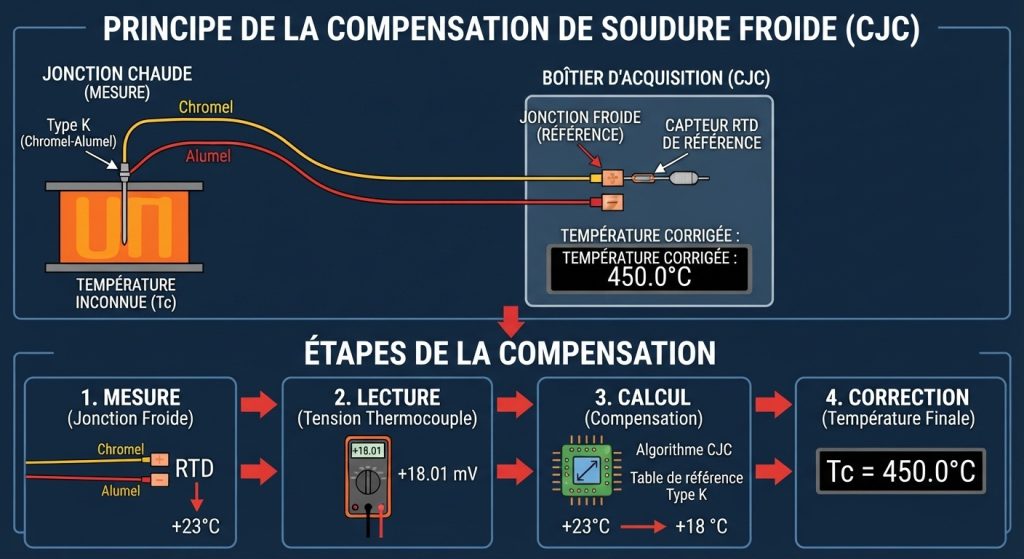
To understand cold joints, we need to go back to the basic principle of a thermocouple. Based on the Seebeck effect, a thermocouple consists of two wires made of different metals (for example, chromel and alumel for Type K) that are welded together at one end.
There are two key junctions:
- The hot junction (or measuring junction): This is the tip of the sensor placed in the medium whose temperature is to be measured.
- Cold junction (or reference junction): This is where the two thermocouple wires connect to the copper terminals of the measuring device (voltmeter, PLC, data acquisition card).
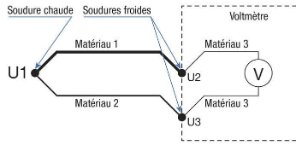
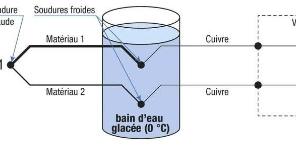
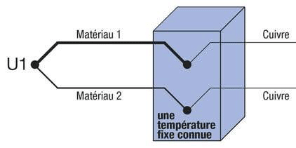
The electrical voltage generated by the thermocouple depends not only on the temperature of the hot junction, but also on the temperature difference between the hot junction and the cold junction.
Simplified formula: Measured temperature = Hot temperature – Cold temperature
The NIST-standardized conversion tables (which are used to convert measured millivolts to degrees Celsius) all assume that the cold junction is exactly 0 °C. However, in reality, your connection terminals are at the ambient temperature of the factory or laboratory (often between 20 °C and 25 °C). If the ambient temperature changes, the voltage fluctuates, introducing a significant measurement error.
The Solution: How Does Offsetting Work?
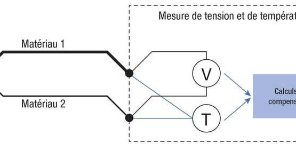
To avoid having to use an ice bath at 0 °C (which is impractical outside a metrology laboratory), modern data acquisition systems use software- or electronics-based compensation.
The process consists of three physical and mathematical steps:
- Ambient Temperature Measurement: A highly accurate, direct-reading temperature sensor (often a PT100 or a thermistor) is placed directly on the terminal block, as close as possible to the cold joint.
- Voltage Conversion: The device calculates the actual temperature of this cold junction and uses standardized tables to determine the virtual electrical voltage that the thermocouple would have generated if its reference point were at 0 °C.
- Final correction: The device’s algorithm adds this theoretical voltage to the actual voltage measured across the terminals. The sum of these two voltages is then used to calculate the exact absolute temperature of the hot spot.
Voltage measured across the terminals + Equivalent cold-weld voltage = Corrected voltage (reference temperature: 0 °C)
Thanks to this real-time processing, modern transmitters and data acquisition modules achieve accuracies on the order of ±0.5 °C or better.
Best Practices for Avoiding Mistakes in the Field
Although compensation is automatic on most modern instruments, several common human errors can compromise the accuracy of your measurement loops:
- Temperature Gradient at the Terminal Block: The reference sensor (RTD) must be at the same temperature as the copper junctions of the thermocouple. Avoid placing the terminal blocks near a heat source (such as a PC fan, radiator, or motor) that could create a local temperature difference.
- Choosing Extension Cables: If you need to extend your thermocouple wires to a remote electrical cabinet, use only extension or compensation cables that are compatible with the same type of thermocouple. Using a simple copper wire would shift the “cold junction” to the wrong location without the PLC being able to detect it.
- Regular Calibration: Drift in electronic components can affect the accuracy of the internal cold-weld sensor. Periodic calibration of your modules using certified industrial calibrators remains essential to validate the measurement chain.
To quickly check whether your cold-junction compensation is working properly, you can disconnect the thermocouple and short-circuit the device’s input connector directly. If the compensation is working correctly, the device should display the exact room temperature.