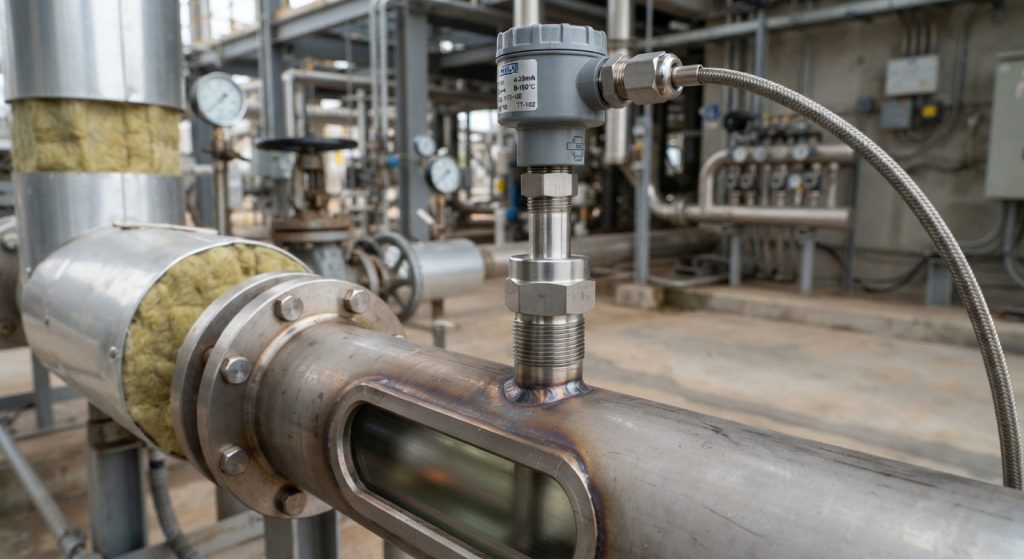
The choice between a mechanically welded liner (a tube welded to a fitting) and a solid-machined liner (machined from a single piece of metal) depends primarily on the pressure, temperature, and fluid velocity requirements of your application.
Here is a guide to help you choose the technology that best suits your needs:
1. Choose a mechanically welded sleeve if:
- Les conditions sont modérées : La pression est basse (généralement < 40 bars) et la vitesse du fluide est faible.
- The budget is limited: They are significantly less expensive to purchase because their manufacture requires fewer raw materials and less machining time.
- The immersion length is important: It is easier and more cost-effective to manufacture long lengths using mechanically welded construction.
- The application is standard: heating, ventilation, and air conditioning (HVAC) or industrial water systems without any major constraints.
2. Choose a solid-drilled sleeve if:
- Pressures and temperatures are high: It offers maximum mechanical strength (no structural weld bead on the submerged portion).
- Fluid velocities are high: It is much more resistant to drag forces and resonance phenomena (vibrations induced by the flow).
- Safety is critical: Applications in the petrochemical, refining, gas, and nuclear industries, where a rupture in the liner would result in a major leak.
- The environment is highly corrosive or abrasive: The absence of a heat-affected zone from welding eliminates weak points susceptible to intergranular corrosion.
Feature Comparison Chart
| Feature | Machine-welded | Drilled into the solid material |
| Pressure resistance | Low to moderate | Very high |
| Vibration Resistance | Limited | Excellent |
| Manufacturing Cost | Economic | High |
| Thermal response time | Often faster (thinner walls) | Slower (thicker wall) |
| Typical Applications | Water, Air, Utilities, Light Industrial Processes | High-pressure steam, hydrocarbons, chemistry |
Golden Rule for Validation: The Design Calculation
If in doubt, or if your fluid is flowing at high velocity, it is strongly recommended (and often mandatory in industrial applications) to perform a calculation in accordance with the ASME PTC 19.3 TW standard. This calculation verifies the strength of the liner against static and dynamic stresses (resonance frequency). If the welded assembly fails the calculation test, the use of a solid-forged sleeve becomes essential.