In the chemical, petrochemical, food processing, and pharmaceutical industries, the presence of combustible gases, vapors, or dust creates a constant risk of explosion. In theseATEX-classified (Explosive Atmospheres) zones, temperature measurement is critical to process safety.
To prevent a temperature sensor (Pt100 RTD probe or thermocouple) from becoming a source of sparks or excessive heat, it must incorporate aspecific protective feature.
Here is an overview of the main protection methods used to secure temperature sensors in hazardous areas.
1. Intrinsic Safety “Ex i”: The Most Common Solution
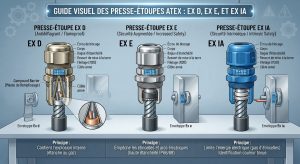
Theintrinsically safeprotection method(Ex ia, Ex ib, or Ex ic)is based on limiting the electrical and thermal energy within the circuit.
- The principle:The sensor signal is routed through an isolation barrier or a protective cell (Zener barrier or galvanic isolator). This limits the current, voltage, and power so that no sparks or heat can ignite the surrounding atmosphere, even in the event of a short circuit.
- Benefits:
- This is the safest mode for areas with a permanent risk (Zone 0/20forEx ia rating).
- It allows you to work on the sensor (for maintenance or to disconnect it) without having to shut off the site's main power supply.
- Ideal application:Standard temperature sensors (Pt100) connected to PLCs via remote intrinsically safe barriers.
2. The “Ex d” Explosion-Proof Enclosure: Containment of the Explosion
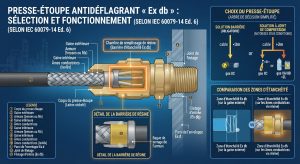
Unlike intrinsic safety, theexplosion-proof (Ex d)method allows for the possibility of a spark or explosion occurring inside the equipment, but ensures that it will not propagate to the outside.
- The principle:The temperature sensor and its connections are enclosed in an extremely rugged connection head or housing. If a gas leaks in and explodes inside, the housing withstands the pressure and cools the hot gases through its flame seals (tight-fitting threads) before they escape.
- Benefits:
- Allows for the use of higher electrical power ratings.
- Exceptionally high mechanical strength in harsh industrial environments.
- Ideal application:Temperature sensors installed in heavy-duty infrastructure (pipelines, refineries) inZone 1/21, often paired with local temperature transmitters that consume a lot of power.
3. “Ex e” Increased Safety: Eliminating Defects
Theincreased safety (Ex e)classification applies primarily to junction boxes and sensor connectors.
- The principle:This protection method involves implementing very strict design measures to prevent, with a high safety margin, the occurrence of sparks, electric arcs, or excessive surface temperatures. Electrical connections are locked to prevent accidental loosening.
- Advantages:Less expensive and lighter than an Ex d explosion-proof enclosure.
- Ideal application:Often combined with other configurations (such as anEx dsensor connected to anEx e junction box) to simplify wiring inZone 1 or 2.
4. “Ex m” Encapsulation Protection and “Ex t” Dust Protection
For specific needs, particularly when dealing with combustible dust:
- Encapsulation (Ex m):Parts that could ignite the atmosphere are encased in a sealed resin. The explosive atmosphere can never come into contact with hot spots or sparks.
- Enclosure Protection (Ex t):Designed exclusively fordust hazards(Zones 20, 21, 22), this method relies on the enclosure’s perfect seal (IP6X) to prevent dust from entering and accumulating on hot internal components.
Comparison Chart to Help You Make Your Choice
| Protection Mode | Main Labeling | ATEX-compliant zone | Security Logic |
|---|---|---|---|
| Intrinsic Safety | Ex i (ia, ib) | Zones 0, 1, 2 (Gas) / 20, 21, 22 (Dust) | Limits the system's electrical power |
| Explosion-Proof Enclosure | Ex d | Zones 1, 2 (Gas) | Contains the explosion within the housing |
| Enhanced Security | Ex e | Zones 1, 2 (Gas) | Mechanically prevents sparks |
| Dustproofing | Ex t | Zones 21, 22 (Dust) | Prevents dust from getting in |
Conclusion: What Strategy Should We Adopt?
To choose the right protection method for your temperature sensor, you must know the following:
Maintenance accessibility: If you need to calibrate or replace your sensors regularly without shutting down the plant,intrinsic safety (Ex i)remains the most flexible solution for day-to-day operations.
The zone classification(0, 1, or 2 for gases; 20, 21, or 22 for dust).
The temperature class of the gas/dustpresent (T1 through T6) to ensure that the sensor will never exceed this surface temperature.