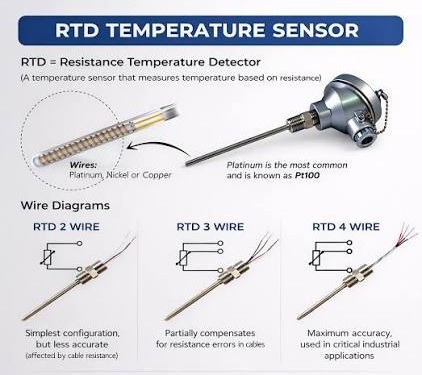
In the field of industrial instrumentation, the Pt100 sensor is the gold standard for temperature measurement. Based on changes in the electrical resistance of platinum (which is exactly 100 ohms at 0 °C), it stands out for its stability and accuracy.
However, when purchasing or installing a system, one technical question always comes up: Should you choose a 2-, 3-, or 4-wire configuration?
The answer depends entirely on one crucial factor: the resistance of the connecting cables. Let's explore together how each configuration affects your measurements.
The Invisible Problem: Line Resistance
To read the temperature, a measuring device (such as a controller or a PLC) sends a small current through the sensor and measures the voltage across it. The problem? The copper wires connecting the sensor to the device also have resistance. If the device is unable to compensate for this parasitic resistance, the displayed temperature will be inaccurate (overestimated).
1. The 2-wire system: Simple and cost-effective
The 2-wire configuration is the most basic setup. Two single wires are used both to power the sensor and to measure the voltage.
- How does it work? The device measures the total resistance of the probe and the two connecting wires.
- The drawback: No compensation. Just a few meters of cable are enough to cause an error of several degrees. Furthermore, if the ambient temperature fluctuates along the cable, the measurement drifts.
- When should you use it? Only for very short distances (less than a few meters) or when accuracy is not a priority at all.
- Tip: If you need to run a 2-wire cable over long distances, choose a Pt1000 sensor, as its higher base value makes the impact of the wires negligible.
2. The 3-wire configuration: The industry standard
This is the configuration you'll find in 90% of industrial applications.
- How does it work? A third wire is connected to one of the terminals of the Pt100. The measurement system uses two separate circuits: one measures the entire line, while the other measures only the resistance of the wire loop so that it can be subtracted mathematically.
- The advantage: An excellent balance between wiring cost and accuracy. Wire resistance is automatically compensated for.
- The requirement: For the compensation to be perfect, the three wires must be exactly identical (same length, same cross-sectional area, same material).
3. The 4-wire configuration: Absolute precision
The 4-wire configuration is the gold standard in metrology and laboratories.
- How does it work? The functions are completely separated. Two wires supply the power (excitation current), while two other wires, connected as close as possible to the sensor, measure the voltage drop.
- The advantage: Since the voltage meter has very high impedance, no current flows through the test leads. Cable resistance is therefore completely eliminated from the equation. The measurement remains highly accurate, regardless of the length or asymmetries of the cables.
- When should it be used? For critical applications, research, calibration, or whenever even the smallest fraction of a degree matters.
In summary
If you’re designing a machine or setting up a standard process, go with the 3-wire configuration without hesitation—it’s recommended by most manufacturers for its value. If you’re looking to eliminate even the slightest measurement uncertainty, the 4-wire configuration is the way to go. Finally, reserve the 2-wire configuration for small-scale laboratory prototypes or very low-cost systems.
Another modern alternative is to integrate a temperature transmitter directly into the probe head to convert the signal to 4–20 mA or IO-Link, thereby permanently eliminating distance-related constraints